
Why Does Charge Rate Matter for Lithium Starting Batteries?
A lithium marine starting battery has to do more than crank the engine. It also has to handle the charging current your outboard sends back while the boat is running.
Overview
Most boaters compare lithium marine starting batteries by the obvious numbers: cranking power, amp hours, weight, size, and price.
Those numbers matter, but they do not tell the whole story. Once the engine is running, the outboard alternator sends current back toward the battery. That is why charge rate and
alternator compatibility matter.
The right starting battery is not just the one that can start the motor. It is the one that can start the motor, support the boat, and accept the charging current the system sends back.
THE QUICK TAKEAWAY
A lithium marine starting battery should not be selected by amp hours alone. Match the battery to the net charging current coming back from the outboard after engine draw and boat loads are accounted for.
The Mistake: Choosing a Starting Battery by Amp Hours Alone
A 100Ah or 120Ah lithium starting battery can look great on paper. It may be compact. It may be lightweight. It may have a strong capacity number on the label. It may even start the engine every time.
But a starting battery does not live in isolation. It lives inside the entire marine electrical system.
That last one is where people get into trouble. A battery can have plenty of capacity to start the engine and still not have enough charge acceptance for the alternator behind it.
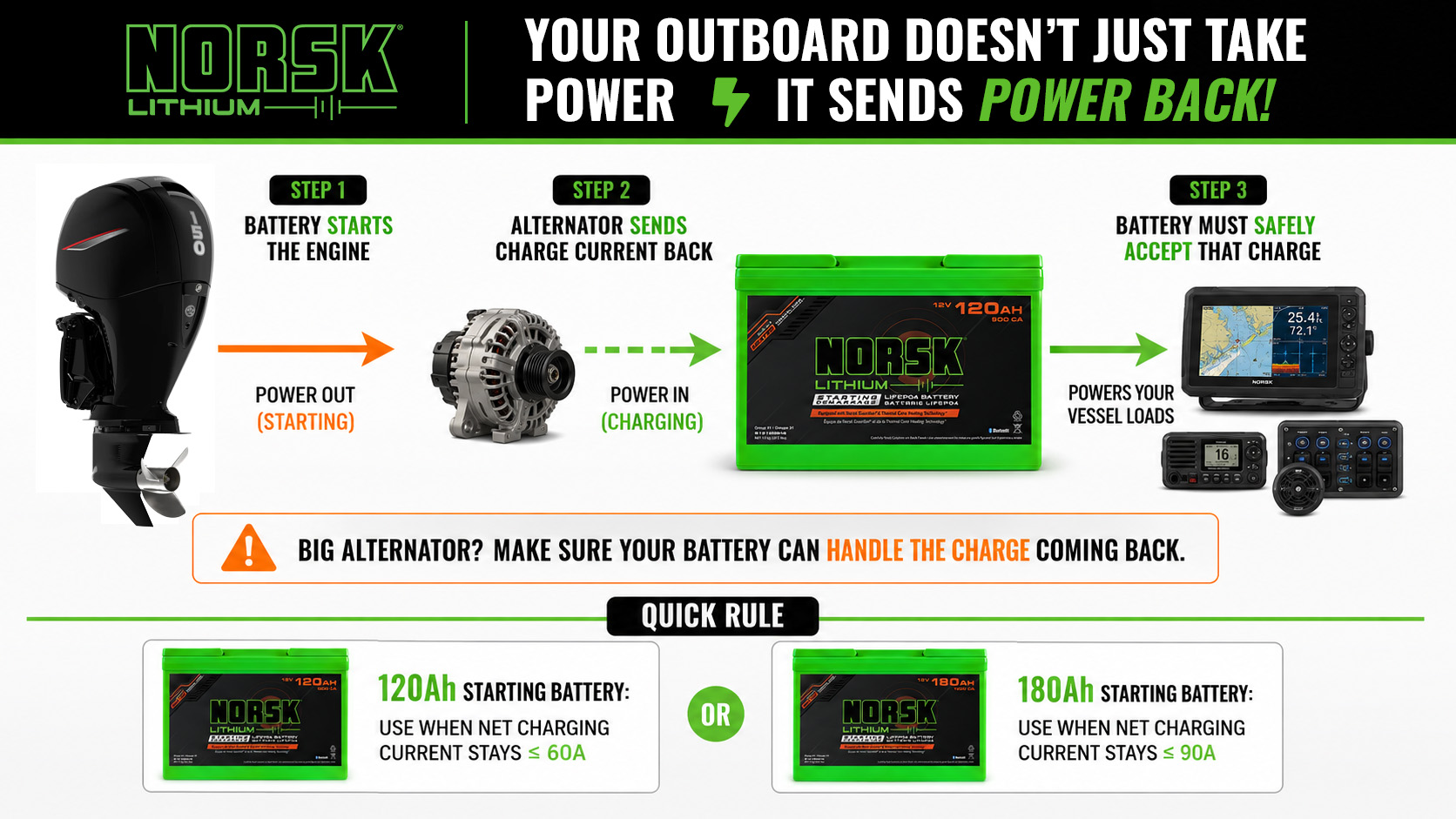
Your outboard does not just pull power from the battery. It sends power back.
Your Outboard Sends Charge Back Into the Battery
Most people only think about the battery at startup. Turn the key. Engine cranks. Engine fires. Done.
But once that outboard is running, the alternator starts sending current back into the battery. On smaller outboards, that charging current is usually manageable. On larger high-output outboards, it is a different story.
A big alternator can push serious current back toward the battery. If the battery is not sized correctly, it may be asked to accept more current than it was built to handle.
Battery selection is a two-way power question.
It is not just about whether the battery can give power to the engine. It is also about whether the battery can safely accept power from the engine.
Gross Alternator Output vs. Net Charging Current
The alternator rating on your outboard is not always the exact amount of current going into the battery. Some current is consumed by the engine. Some current is consumed by vessel loads. Some current goes to onboard electronics and accessories.
What is left is what the battery may actually need to absorb. That is called net charging current.
Alternator Output
Gross charging output available from the outboard.
Engine + Vessel Loads
Current used by the engine, electronics, pumps, and accessories.
Net Current to Battery
The current the battery may actually need to accept.
Proper sizing should always account for worst-case conditions: low battery state of charge, high RPM operation, minimal accessory loads, large alternator output, and long engine run time. That is when the battery may be asked to accept the most current.
120Ah vs. 180Ah: Matching the Battery to the System
The Norsk Lithium 12V 120Ah Heated Lithium Cranking Battery is an excellent fit for many marine applications. It offers dependable cranking power, Emergency Start Reserve, Deep Sleep, triple terminals, Thermal Core Heating Technology, Guardian app integration, IP67 protection, and a 10+2 year warranty with registration.
But that does not mean it is the correct battery for every outboard.
12V 120AH HEATED LITHIUM CRANKING BATTERY
Recommended maximum net charge current: 60 amps.
A strong choice for smaller and mid-range charging systems where alternator output and real-world net current stay within the proper range.
View 120Ah Battery12V 180AH HEATED MARINE CRANKING BATTERY
Recommended maximum net charge current: 90 amps.
Additional charge acceptance gives larger alternator systems, heavier electronics loads, and higher-demand marine setups more room to operate within the proper range.
View 180Ah BatteryThe goal is not to install the smallest lithium battery that can crank the engine. The goal is to install the correct battery for the entire boat.
Choose the Battery by the System, Not the Label
Net charging current stays at or below 60 amps, electrical demand is moderate, and the outboard charging system falls within the battery's charge acceptance range.
You are running a larger alternator outboard, net charging current may exceed 60 amps, you need up to 90 amps of recommended net charge acceptance, or you want additional capacity and system margin.
Not: “Will this battery start the engine?” Better: “Can this battery handle the charge coming back from the engine?”
Alternator Compatibility Guide
This compatibility guide belongs directly in the article because it turns the charge-rate concept into a clear buying decision. Start with the alternator gross output, estimate the approximate net current to the battery, and then match the battery to the system.
Match the starting battery to the alternator system.
The table below is based on the Norsk 120Ah and 180Ah starting battery compatibility guidance. Use it as a planning guide, then confirm your exact outboard, wiring, regulator behavior, and installation conditions.
| Alternator Gross Output | Approx. Net to Battery* | 120Ah Starting Battery | 180Ah Starting Battery |
|---|---|---|---|
| <70A | <55A | Acceptable | Acceptable |
| 85A | 60-70A | Parallel Required | Acceptable |
| 100-115A | 70-85A | Not Allowed | Acceptable |
| 150A | 75-95A | Not Allowed | Verify ≤90A |
| >150A / Dual | >100A | Not Allowed | Parallel Required |
*Approximate net current to battery may vary by alternator, wiring, regulator behavior, and installation conditions.
Parallel connection required means certain applications require batteries in parallel to distribute charging current and help protect the battery and BMS from overcurrent and overheating.
Important: Mercury and other OEMs may require an isolator or ACR. These devices manage battery-bank connection; they do not automatically limit current.
The alternator matters. The boat's load matters. The net charging current matters.
Two boats with similar engines may need different starting battery setups.
What About Isolators and ACRs?
It is important to understand what these devices do and do not do when you are sizing a lithium marine starting battery.
What is an Isolator?
A battery isolator allows one charging source to feed multiple battery banks while keeping those banks separated. It helps manage routing, but it is not a substitute for correct battery charge acceptance.
What is an ACR?
An Automatic Charging Relay manages when battery banks connect and disconnect. It can combine batteries when charging is present and separate them when charging stops, but it does not automatically limit current.
Both devices can play an important role in marine rigging, but they do not automatically solve an alternator-to-battery mismatch. They help manage battery-bank connection strategy. They do not change the real charging current the starting battery may be asked to accept.
That means adding an isolator or ACR does not automatically make a small lithium starting battery safe behind a large outboard alternator. Battery sizing still needs to be based on real net charging current, not just the presence of extra rigging hardware.
Key takeaway: An ACR or isolator may manage how current is routed through the system, but it is not a substitute for choosing a starting battery with the correct recommended charge acceptance.
Why “Do Not Connect Anything Else” Should Raise Questions
Some lithium starting battery companies tell customers not to connect anything else to the battery. On a real boat, that instruction raises a bigger question: why?
Modern starting batteries often support more than just the starter. Many boats use the starting battery to support graphs, engine electronics, GPS, pumps, livewells, lights, jack plates, shallow water anchors, power brakes, and other onboard accessories.
If a company says not to connect anything else, it may be because the battery is not built or sized to handle the full real-world marine system.
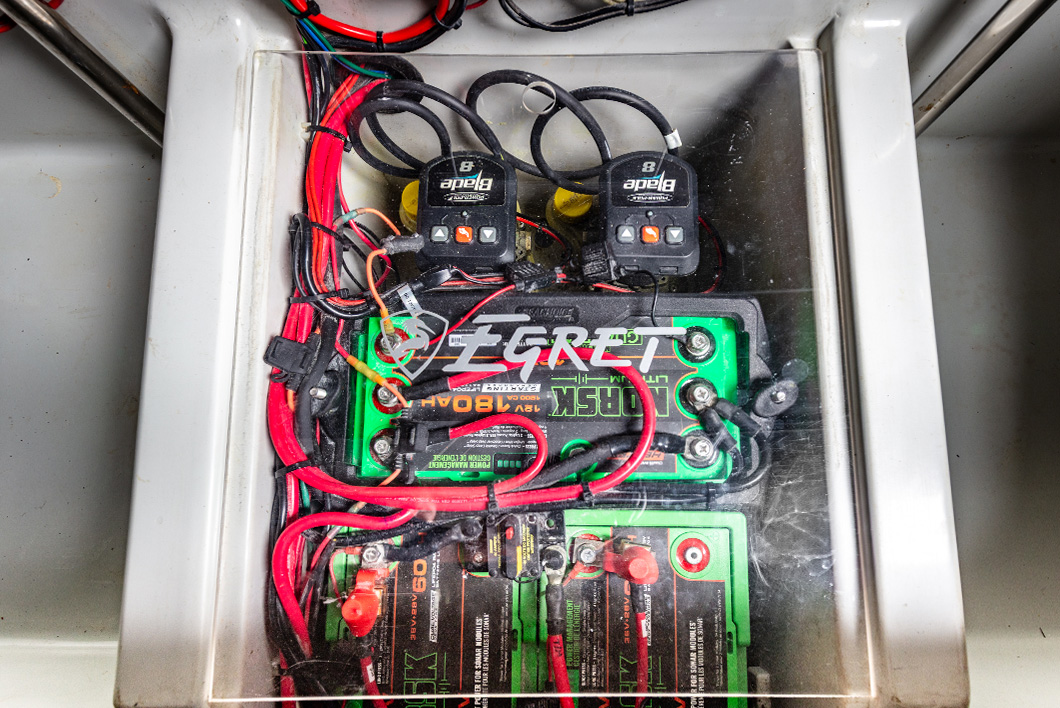
Real boat systems are connected systems. Starting power, electronics, pumps, and accessories all matter when sizing the battery.
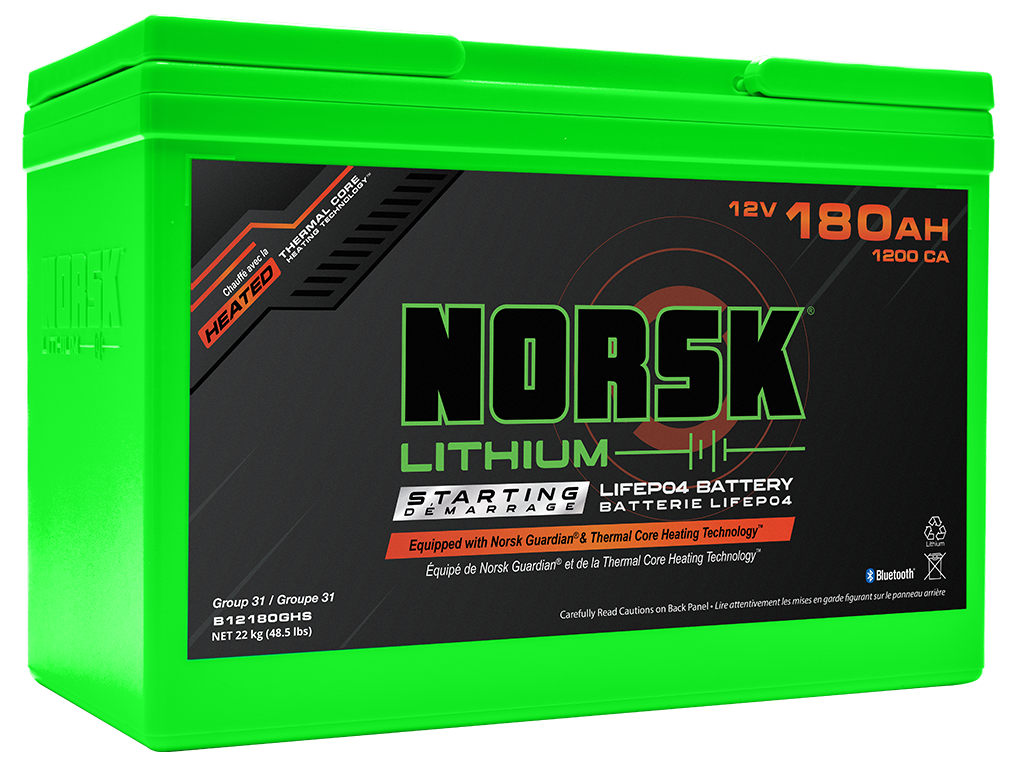
Today's starting battery is not just a basic cranking battery.
It is the backbone of the boat’s electrical system. Norsk Lithium starting batteries are designed for modern marine rigging with triple terminals, Norsk Guardian® app integration, Emergency Start Reserve, Deep Sleep™, Battery Meter, Power Management button, and marine-focused construction.
The Hidden Spec Most Boaters Miss
Tell you capacity.
Tell you starting capability.
Tells you whether the battery can handle what the outboard sends back.
The Bottom Line
For many compatible applications, the Norsk Lithium 12V 120Ah Heated Lithium Cranking Battery is a powerful and reliable choice. But for larger alternator outboards and higher-demand marine systems, the Norsk Lithium 12V 180Ah Heated Lithium Marine Cranking Battery may be the correct battery because it offers higher recommended charge acceptance and more system margin.
The wrong battery might start the engine. That does not mean it belongs behind it.
When your outboard sends power back, your battery needs to be ready. That is why charge rate matters. And that is why proper battery sizing is just another reason Norsk Lithium is Superior Lithium Power.

Need Help Sizing?
Have More Questions?
Ask Odin for help matching your starting battery to your outboard and system demand.
Charge Rate FAQ
What is charge acceptance?
Charge acceptance is how much charging current a battery is designed to accept from a charging source, such as an outboard alternator. For lithium marine starting batteries, this matters because the battery must safely accept current after the engine is running.
Is alternator output the same as net charging current?
No. Alternator output is the gross output rating. Net charging current is what may remain after engine draw, vessel loads, electronics, pumps, and accessories are accounted for.
Can an isolator or ACR limit charging current?
Not necessarily. Isolators and ACRs can manage how battery banks connect or separate, but they do not automatically solve an alternator-to-battery mismatch or limit the real charging current the battery may see.
Why does charge rate matter for lithium starting batteries?
Charge rate matters because a starting battery does more than crank the engine. Once the outboard is running, the alternator sends current back toward the battery. If the battery is not sized for that net charging current, it may be the wrong battery for the system.
When should I choose the 180Ah starting battery instead of the 120Ah?
Choose the 180Ah model when the outboard, alternator system, electronics load, or desired system margin calls for up to 90 amps of recommended net charge acceptance instead of 60 amps.
Where do I find the alternator compatibility guide?
The alternator compatibility guide is included on this page and also appears under the Compatibility tab on the Norsk 120Ah and 180Ah lithium starting battery product pages.
Size the Battery to the Whole System
Explore Norsk Lithium marine starting batteries designed for modern outboards, onboard electronics, alternator charge acceptance, and real-world marine rigging.
View Marine Batteries